
As simply as possible, here are the basics….
What is Tarot?
Tarot is a tool for divination, reflection, story telling, pattern recognition ….it is not (directly) prediction or fortune telling.
It is a deck of 78 cards, each card is individually illustrated, together they make up a pictorial system of symbolic representation that encompasses the whole human experience.
How does a deck of 78 tarot cards describe the whole human experience?
The 78 cards are made up of 22 Major Arcana cards and 56 Minor Arcana.
The Major Arcana describe the big events of life, the Minor Arcana represent the every day.
The 22 Major Arcana cards visually represent the Fool’s Journey from ignorance to wisdom and maturity.
The 22 cards take us through major stages of life, the ups and downs, moments of learning transformation and understanding until we arrive at the World, the final card of the Major Arcana that represents completion. We are complete, and at one with life, we are enough, in the right place at the right time. The cycle of growth and learning is complete. And then we return to the start with the Fool for another cycle in our lives.
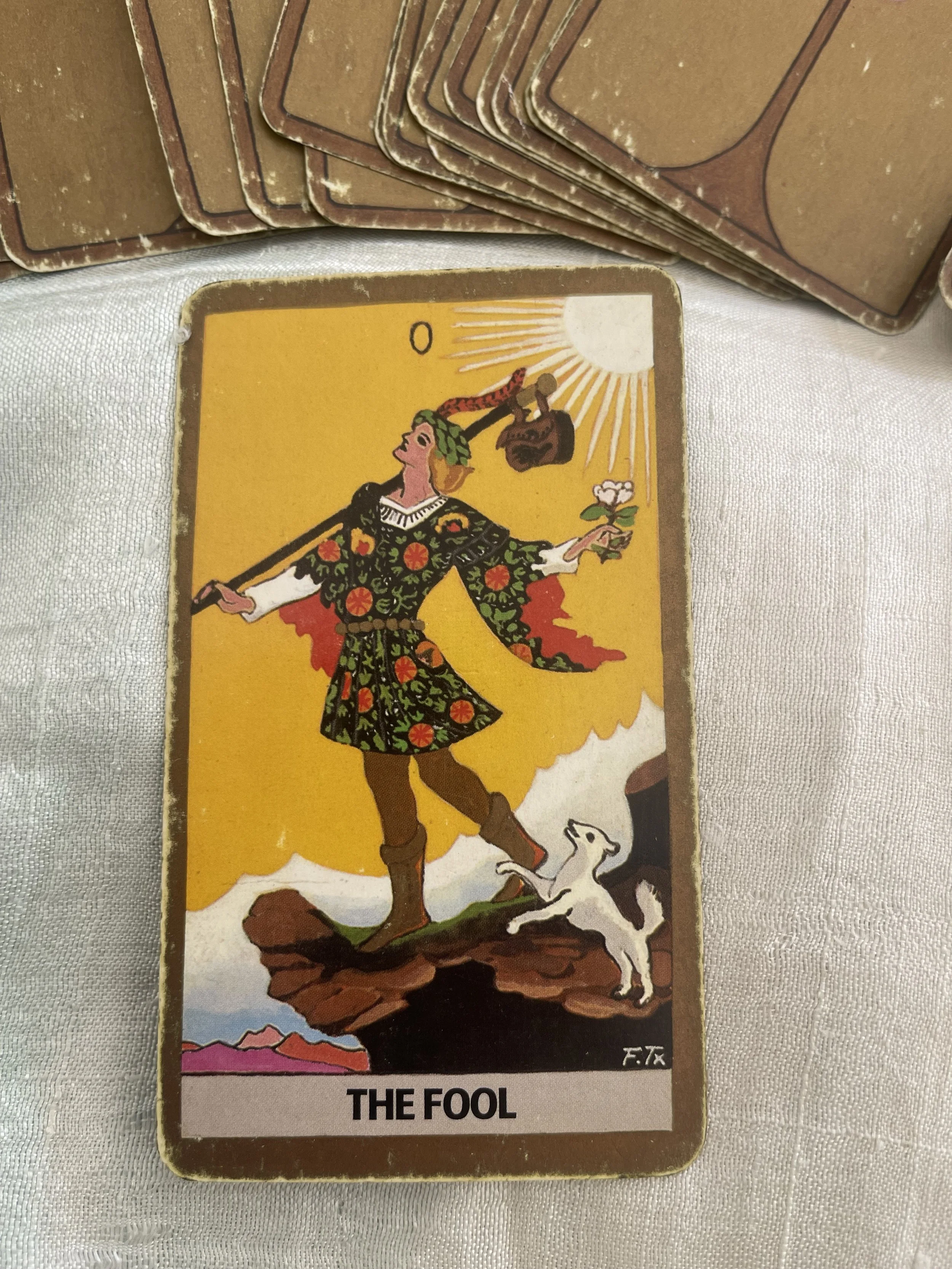
The first card of the Major Arcana out of 78 in a Tarot deck
The Fool represents the leap of faith we take into the unknown and even though we don’t know how the world works, with optimism and faith we set off on a new cycle of life.
The first six major arcana cards teach us that we have all the tools to navigate life, we learn that with being able to combine intuition, creativity and imagination plus discipline and determination to empower ourselves, we can CHOOSE what we want in life.
These steps in our growth are represented by the first six cards of the Major Arcana
The Fool, The Magician, The High Priestess, The Empress, The Emperor, The Lovers.
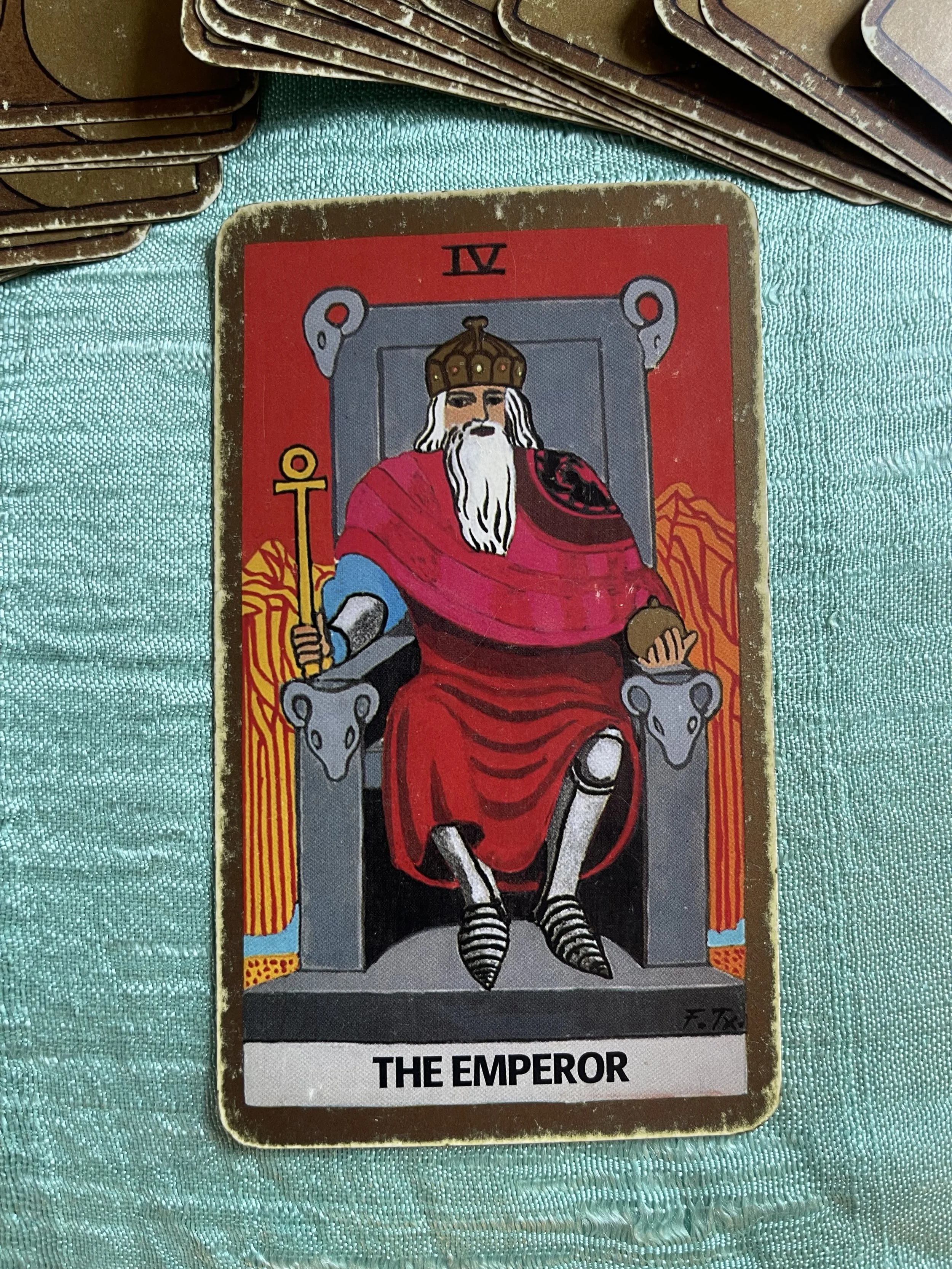
The fourth card of the Major Arcana where we learn how to empower ourselves.
Along our journey we encounter major architypes who impart aspects of knowledge and abstract concepts like the Wheel of Fortune, Justice, Death, The Tower, The Star, Sun, Moon until we complete the cycle with final Major Arcana card, the World.
56 Minor Arcana (every day life) is made up of four suits
THE MINOR ARCANA (THE FOUR SUITS)
Wands (Fire) drive creativity action passion
Cups (water) emotions, relationships, intuition
Swords (air) thoughts, will, identity, decisions
Pentacles (earth) work, money, physical body, society
THE COURT CARDS, Page, knight, queen, king represent people, personality traits, their rank and position depicting youth to maturity
· Wands: Curious spark (Page), bold go-getter (Knight), charismatic vision-keeper (Queen), decisive leader (King).
· Cups: Sensitive messenger or daydreamer (Page), romantic or moody pursuer (Knight), deeply empathetic carer (Queen), emotionally steady guide (King).
· Swords: Inquisitive thinker or news-bringer (Page), sharp or impulsive debater (Knight), perceptive strategist (Queen), analytical authority (King).
· Pentacles: Diligent learner or practical tip (Page), steady or stubborn worker (Knight), grounded resource-builder (Queen), reliable provider or manager (King).
History - how a simple card game became a tool for Divination?
- Playing cards entered Europe in the 15 century, from india, egypt, china korea?
- Northern Italy played Tarocchi, a trick or trump game rather like bridge today. 4 suits. 3 court/face cards.
- A couple of decades later the card playing nobles of the Renaissance started commissioning elaborately painted cards to represented their lineage, Christian and civic life. E.g. The Heirophant (Pope) The Emperor, Justice. As well as allegorical art that personified abstract concepts Death, Hanged Man, Tower etc.
- These additional face/trump cards became the 22 Major Arcana
- Tarocchi now Tarot also became very popular in the south of France. It was a parlour game, played for fun.
- By late 18 century interest in the occult is blooming in Europe which is when Tarot began to be used for fortune-telling.
- 1770s (cardomancy fortune telling )Jean-Baptiste Alliette published the first Tarot deck specifically for divinatory purposes.
- 1909 Rider Waite created by Arthur Edwards Waite and illustrated by the brilliant Pamela Coleman Smith which is the definitive deck we use now. Before that the pip cards had no decoration. (perhaps show cards here ?)
How do you read the cards?
Everything depends on the combination of cards you pull randomly from the pack of 78, their relationship to each other, and the position they represent in a tarot reading spread.
There are all sorts of spreads created for different questions, whereby the position of the card helps interpret its meaning as part of the whole
I always start with the Celtic cross, 10 cards, which gives you a snap shot of the over all situation. The ten cards represent the root of the situation, present situation, what the challenge is, what is crowning i.e. happening right now, future, future self, home & heart, hopes and fears, probable outcome and background.
There are spreads for problem solving, looking at relationships, career, finding love.
I always say Tarot is. Not predictive, yes it shows you the potential at hand, but it is up to us how we act i.e. it’s more proactive in that we get to see our situation objectively from cards and the reader who have no bias. And are encouraged to take action.
The cards help you explore ideas you might not have thought of, typically ideas you’ve thought of but discarded as impossible or difficult.
They give you insight into yourself and your relationships, into every area of your life and can be used strategically for career decisions, all sorts of decisions.
Do come and have a reading with me I always say….
Tarot is a practical tool for self-awareness, problem solving, decision making, that can help activate our full potential.